
| Timing Accuracy | 6 min/year at 25° C 30 min/year -20 to +40° C 47 min/year -40 to +70° C |
|---|---|
| Available Sensors | Mortality, Activity, Temperature, Low Voltage. Salt water switch also available on select models. |
| Argos Operating Frequency | ARGOS Frequencies: 401.6300MHz to 401.6800MHz in 1 kHz Steps Brazilian SCD-1: Channels C1 to C9 401.6180MHz to 401.6220MHz in 500Hz Steps |
| Argos Frequency Stability | ±0.5 ppm maximum from -30° to +70° C ±2.0 ppm maximum from -40° to -30° C |
| Argos Initial Frequency Error | ±0.5 ppm maximum at +23°C, ±2° C |
| Argos Frequency Aging | ±2.0 ppm maximum after 1 year |
| Argos RF Power Out | 250mW (+24.0dBm ±2dB) standard, 150mW (+22.5dBm ±2dB) option, both nominal into 50 Ω (User selectable using TPP programming software) |
| Argos Spurs and Harmonics | <-40dBc minimum, -60dBc typical (Coherent Spurious) <-50dBc minimum, -60dBc typical (Non-coherent spurious) |
Argos Marine Transmitters (TAM)
Argos only, without GPS
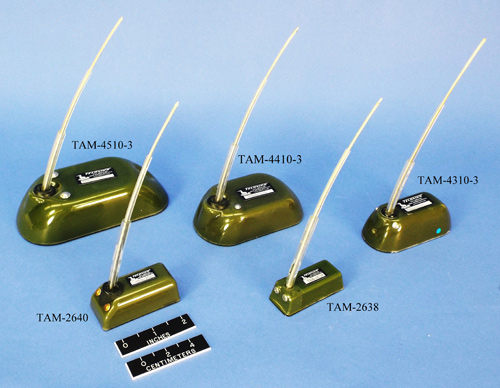
Five fully configured models designed specifically for marine applications are shown. Tubing provides strain relief and mechanical protection for the antenna assembly.
Models
TAM-26xx Models
| Model | Dimensions L x W x H (in, cm) | Weight (g) | Operational Life (days) 3-byte message |
Operational Life (days) 31-byte message |
|---|---|---|---|---|
| TAM-2638 | 2.5 x 1.1 x 0.7 6.4 x 2.8 x 1.8 |
49 | 150 | 60 |
| TAM-2640 | 2.7 x 1.3 x 1.0 6.8 x 3.3 x 2.5 |
90 | 600 | 250 |
Operational life is based on Argos transmissions with 250 mW output, 45-second repetition rate, 3-byte (minimum) or 31- byte (maximum) message length, 12-hours per day; with 75% of time spent underwater, and temperatures of 25°C.
TAM-4xxx-3 Models
| Model | Dimensions L x W x H (in, cm) | Weight (g) | Operational Life (days) 3-byte message |
Operational Life (days) 31-byte message |
|---|---|---|---|---|
| TAM-4310-3 | 4.0 x 1.8 x 1.2 10.3 x 4.6 x 3.0 |
150 | 280 | 110 |
| TAM-4325-3* | 160 | |||
| TAM-4410-3 | 4.6 x 2.5 x 1.3 11.7 x 6.4 x 3.2 |
255 | 690 | 280 |
| TAM-4425-3* | 265 | |||
| TAM-4510-3 | 5.9 x 2.9 x 1.5 14.9 x 7.4 x 3.9 |
455 | 1500 | 670 |
| TAM-4525-3* | 465 |
Operational life is based on Argos transmissions with 500 mW output, 45-second repetition rate, 3-byte (minimum) or 31- byte (maximum) message length, 12-hours per day; with 75% of time spent underwater, and temperatures of 25°C.
*TAM-4x25-3 models include a pressure transducer and can provide depth of dive and other pressure-related data.
Key Features
- These TAM models operate through the Argos System. This satellite-based system provides global coverage and particularly good performance in the polar regions. Animal locations are calculated using the Doppler-shift in frequency of the transmitter's uplink transmission. (These units do not use GPS for location determination.).
- The TAM-26xx models provide small, light-weight packages for smaller species or juveniles. These units use Telonics ST-26 electronics, have 250 mW standard output power, and can collect and transmit data such as last dive time, dive count, maximum and average dive time, percentage of time spent under water, and temperature.
- The TAM-4xxx models provide 500 mW standard output power using the µGPSI-23 electronics, and can include not only dive time-related and temperature data, but also pressure-related data such as depth of dive, profile of a single dive, and percentage of time in user-defined depth layers (TAM-4x25-3 units include a transducer and can provide pressure data). Other features included in the TAM-4xxx, but not the TAM-26xx units are:
- All data is stored in non-volatile memory, such that it can be downloaded if the unit can be recovered.
- Support highly compressed data transmission called page data.
- A VHF transmitter is also included and can be enabled. It shares the transmitting antenna with the Argos transmitter.
- Expanded operational temperature range of -40°C to +70°C.
- Salt-water-switch (SWS) synchronizes Argos transmissions with surfacings and suppresses them while underwater to save energy. The SWS allows collection of dive data including length of dives, dive count, and percentage of time spent under water. Units can also be programmed to shut down Argos transmissions after a defined "haul-out" period to save energy. Normal data collection and Argos transmissions are resumed when the SWS is again submerged. The SWS settings on the TAM-4310 and larger models can be selected to allow detection of either seawater, or most freshwater and seawater (submergence may not be able to be detected in water with very low conductivity).
- Argos transmissions can be duty-cycled (e.g. daily and seasonal cycles), and the number of Argos transmissions in a defined interval can also be limited (e.g. not more than 100 within 6 hours), to extend operational life. A real-time clock/calendar controls all timing functions.
- These models can be programmed using Telonics Product Programmer (TPP). TPP makes it possible for users to program their own systems and simulate performance of the system prior to deployment.
- On-board sensors can be activated or deactivated. Data collection regimes and schedules can be altered. Sensor data can be added or deleted from Argos transmissions.
- Argos ID codes, transmission frequencies, transmission power levels, and transmission schedules can all be modified.
- Telonics Data Converter (TDC) is used to download data from a unit in hand, or to process the highly compressed "page" data used when transmitting large amounts of data through Argos. TDC provides complete data decoding of Argos DS files, including location and sensor data, and provides a plot of locations in Google Earth. More simple data formats do not require processing of via TDC.
- These models are internally solidly cast to withstand high pressures experienced during deep ocean dives. In general, the battery system determines how much pressure the unit can withstand. Most fully cast configurations can withstand pressures exceeding 1500 psi if the exposure is short term.
- Powered by primary battery, and can be turned on or off using a magnetic switch. When turned off, TAM-26xx units consume less than 5.3 µA, and TAM-4xxx units consume less than 12 µA.
- Can be refurbished to their original condition at the factory.
Specifications: Electronic and Packaging
TAM-26xx ST-26 (Argos Certified Transmitter) Specifications - Show
µGPSI-23 GPS/Argos/VHF Specifications - Show
General Specifications
| Timing Accuracy | Timing is synchronized to GPS time when available. If GPS time is not available, then internal timing accuracy is: 6 min/year at 25° C 30 min/yr -20 to +40° C 47 min/yr -40 to +70° C |
|---|---|
| Available Sensors | Mortality, Activity, Temperature, Low Voltage (as allowed by specific software) Salt-water-switch and Pressure are hardware and software options on some configurations. |
| Memory Capacity | Capable of storing ~500K fixes in nonvolatile flash memory in association with other sensor data. |
| Programming | Programmable using Telonics TPP software and TSC-9A cable. Programming options are hardware and software dependent, but include GPS, Argos, and VHF schedules; sensor activation and schedules; power output; Argos can also be scheduled to transmit only during satellite overpasses based on the GPS location and the orbital parameters installed prior to deployment. |
Argos Transmitter Specifications
| Operating Frequency | ARGOS Frequencies
401.6300MHz to 401.6800MHz in 1 kHz Steps Brazilian SCD-1, Channels C1 to C9 401.6180MHz to 401.6220MHz in 500Hz Steps |
|---|---|
| Frequency Stability | ± 0.5 ppm maximum from -30° to +70° C ± 2.0 ppm maximum from -40° to -30° C |
| Initial Frequency Error | ± 0.5 ppm maximum at +23°C, ± 2° C |
| Aging | ± 2.0 ppm maximum after 1 year |
| RF Power Out | Standard Power version: 500mW (+27dBm), 400mW (+26dBm) option, into 50 Ω (User selectable using TPP programming software) High Power version (H): 800 mW (+29 dBm) ±1dB nominal into 50 Ω (available in some configurations) |
| Spurs and Harmonics | <-40dBc minimum, -60dBc typical (Coherent Spurious) <-50dBc minimum, -60dBc typical (Non-coherent spurious) |
VHF Transmitter Specifications
| Available Frequency Options |
Option 702 134-139 MH Option 705 140-154 MH Option 707 146-160 MH Option 715 156-172 MH Option 720 160-177 MH Option 740 174-192 MH Option 750 191-210 MH Option 760 210-237 MH Note: Frequency can be programmed in 100Hz steps within a given frequency range. |
|---|---|
| Frequency Stability | Better than ±3ppm at room temperature ±5 ppm total tolerance over full temperature range |
| Operating Temperature | -40° to +70° C |
| Pulse Width | Programmable (10 to 250 msec) |
| Pulse Period | Programmable (265 to 5000 msec) Multiple pulse periods selectable per specific software and TPP |
| Transmitter Timing | Programmable, including daily and seasonal duty cycles. |
| Power Output | Selectable levels via hardware and software. Effective Isotropic Radiated Power (EIRP) varies, depending on packaging, antenna configuration, and immediate environmental conditions. *California Users: This transmitter meets the California requirement of EIRP < 0.0009W for all configurations. |
| Emission Designator | 2k00P0N |
| Harmonic Suppression | Better than 30dB (>40 dB typical) |
| Spurious Emissions | <-35 dBc at 10 kHz offset from carrier |
| Frequency | Aging: <2ppm/year Shock: <1ppm 3000g x 0.3ms x ½ sine x 3 dir |
| VSWR | RF output stable to 10:1 VSWR, all phases Radiated harmonic levels are degraded with poor load VSWR. Spurious emission specification maintained for >10:1 VSWR |
Related Products
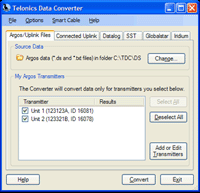
Telonics Data Converter (TDC) is used to convert raw data from Telonics transmitters into data reports and to display locations on Google Earth and Google Maps. You can review TDC reports in Microsoft Excel or other spreadsheet programs.
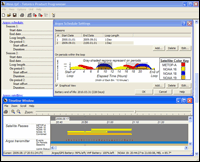
TPP Telonics Product Programmer
Telonics Product Programmer (TPP) is a powerful software tool used to program Telonics transmitters, and Telonics CR-5 and CR-7 collar release mechanisms. TPP gives you the ability to modify aspects of your Telonics GEN4 GPS and VHF transmitters including data collection and transmission intervals. TPP is designed for ease of use, with simple point-and-click navigation through the program.
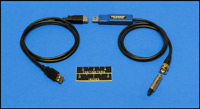
The TSC-9A is a multi-use interface cable terminated with a USB A connector and a male BNC (bayonet style) connector. The cable is used to connect various Telonics products to a computer when using Telonics Product Programmer (TPP), Telonics Data Converter (TDC), or the CR-2a BCP-2 programming software. The BNC connector allows quick and easy attachment of various adapters.
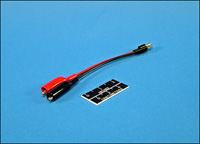
Adapter, female BNC to alligator clips for use with the TSC-9A cable. This adapter is used for systems where programming/download connections are made using the antenna tip or saltwater switch buttons.
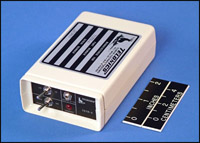
The TSTR-4 provides transmit indication for Argos PTTs (401.650 MHz). Provides both a visual indicator and audio tone with each transmission. Operates on a standard 9 volt battery. Designed specifically for short range (2-3 feet) testing of Argos transmitters.
Related Links to Information on Other Websites
Legacy Products
This information on discontinued products is provided for individuals who are still using these older systems. Product descriptions may be time sensitive or even outdated. Please contact Telonics if you have questions.
Telonics supports these products as possible based on availability of parts, software, or other considerations; but no longer sells them new.
Key Features
- The A-xxx series data as last dive time, dive count, maximum and average dive time, percentage of time spent under water and temperature can be transmitted. In addition, the A-xxx series can also be configured with a pressure transducer. Depth of a dive, profile of a single dive and percentage of time in user defined depth layers are available.
A-xxxx Specifications (Uses the ST-21 Argos Certified Transmitter) - Show
| Timing Accuracy | 6 min/year at 25° C 30 min/yr -20 to +40° C 47 min/yr -40 to +70° C |
|---|---|
| Available Sensors | Mortality, Activity, Temperature, Low Voltage |
| Argos Operating Frequency | ARGOS Frequencies: 401.6300MHz to 401.6800MHz in 1 kHz Steps Brazilian SCD-1: Channels C1 to C9 401.6180MHz to 401.6220MHz in 500Hz Steps |
| Argos Frequency Stability | ±0.5 ppm maximum from -30° to +70° C ±2.0 ppm maximum from -40° to -30° C |
| Argos Initial Frequency Error | ±0.5 ppm maximum at +23°C, ±2° C |
| Argos Aging | ±2.0 ppm maximum after 1 year |
| Argos RF Power Out | Standard Power Version: 450mW (+26.5dBm ±2dB) or 630mW (+28.0dBm ±2dB) nominal into 50 Ω (User selectable using TPP programming software) Note 1: At +70°C, transmit current will increase by approximately 10% from the +25° C measurement. Conversely, at -40° C it will decrease by approximately 10% from the +25° C measurement. Note 2: Transmit current and RF power out are sensitive to VSWR. Both can be degraded significantly if the antenna or antenna coax are of poor quality or not correctly tuned and matched to the ARGOS/Brazilian frequency band 50 ohm RF output impedance. |
| Argos Spurs and Harmonics | <-40dBc minimum, -60dBc typical (Coherent Spurious) <-50dBc minimum, -60dBc typical (Non-coherent spurious) |
| A-xxxx Packing/Housing Specifications | Designed for application on most pinnipeds and most marine turtles. Units are enclosed in a polymeric casting to withstand pressures of 1000 psi. The external casting shell is of a contoured design to minimize hydrodynamic drag. Saltwater switches are installed in the housing to allow the unit to detect diving behaviors. The Argos antenna assembly employs a strain-relief to avoid breakage. |
Telonics no longer supports or refurbishes the following products:
Lithium Battery Shipping Regulations
Telonics Inc. ships all systems containing lithium batteries in accordance with the US Department of Transportation rules for hazardous materials set forth in 49CFR and the IATA Dangerous Goods Regulations.
Shipping dangerous goods can be complicated and confusing, consult a dangerous goods specialist if needed. The general requirements for shipping lithium batteries according to 49CFR are located in Part 173, Subpart 173.185 in the link below.
http://www.ecfr.gov/cgi-bin/text-idx?SID=e8334217c2c8d081457a5156872ad037&tpl=/ecfrbrowse/Title49/49cfrv2_02.tpl#0
Service Commitment
Since 1970, Telonics has built a reputation based on product quality, product support, service, and customer satisfaction. Telonics strives to produce the highest quality products, and to support those products accordingly.
Because of extreme conditions and the unpredictable nature associated with most telemetry applications, problems occasionally arise. Most problems can be resolved quickly. In all cases, we hope to be able to work in partnership with users to resolve problems to the user's satisfaction and to uphold our demonstrated commitment to excellence. If problems should arise, all products must be returned to our factory for failure analysis.
Warranty: Argos Systems - Show
Telonics warrants its Argos products to be free from defects in material and workmanship for a period of one year from the date acquired. Telonics does not warrant batteries.
If a defect occurs, return the equipment to us within the proper time frame at the following address: TELONICS, 932 E. IMPALA AVENUE, MESA AZ USA 85204-6699. The customer shall arrange for and pay all shipping, insurance and related charges incurred in the shipment to and from Telonics under this warranty. Damage to any equipment resulting from misuse, accidents, unauthorized service, extreme conditions, or other causes, is excluded from this warranty. Telonics does not assume responsibility for loss or damage to equipment during shipment. Telonics does not assume responsibility for delays resulting from shipment on commercial or private carriers. We insure all equipment shipped from our facility and suggest that shipments to Telonics also be insured.
Upon the timely return to our facility, if defective, the product will be replaced or repaired at our discretion at no cost to the customer. This remedy is the exclusive remedy. This product is supplied without any further warranties or conditions, expressed or implied, including warranties of merchantability, quality or fitness for particular reason or those arising by laws, statutes or trade usage or course of dealing.
The entire risk, as to the results and performance of the product, is assumed by the customer. Neither Telonics, nor its suppliers, shall have any liability to the customer or any other person or entity for any indirect, incidental, special, or consequential damage whatsoever, regardless whether Telonics has been told of the possibility of such damages or that such damages might be foreseeable. Telonics has no responsibility or liability for the claims of any third party. The maximum aggregate to the customer, of Telonics and its suppliers, shall not exceed the amount paid by the customer for the product.