A-1025 Telonics Argos Marine Transmitter
The information below on discontinued products is provided for individuals who are still using these older systems. Product descriptions may be time sensitive or even outdated. Please contact Telonics if you have questions.
| Dimensions L x W x H |
Unit Weight
(g) |
Pressure Sensor |
Low power
(mW) |
Low power
life (hours)1 |
Low power
temp (°C) |
High power
(mW) |
High power
life (hours)1 |
High power
temp (°C) |
2.4 x 4.85 x 1.23 in
6.0 x 12.3 x 3.1 cm |
331 |
Yes |
500 (Typ) |
1874 |
-30 to +60 |
1000 (Typ) |
739 |
-30 to +60 |
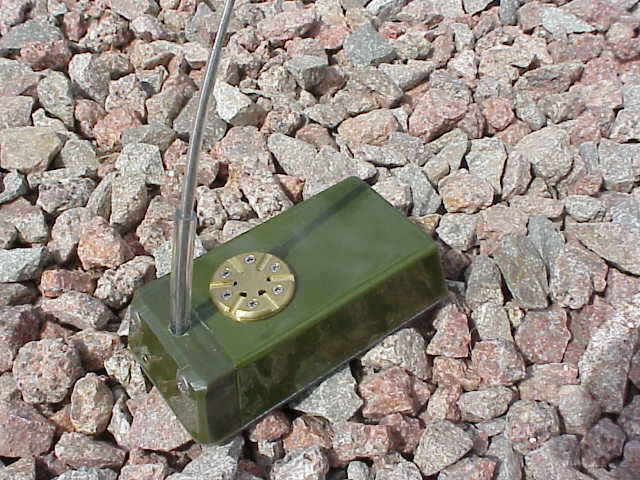
The A-1025 Telonics Argos Transmitter is a highly versatile Argos Data Collection and Location Platform designed for research on marine mammals and turtles. This model can be programmed to transmit either a 500 mw or 1 watt Argos uplink. The higher power levels are particularly advantageous in high radio-noise environments such as Europe and the Middle East. The lithium battery system employed in this model is "nonhazardous". Therefore, domestic and international shipments can use standard ground and air carriers without restriction.
The A-1025 is equipped with a pressure transducer to measure subsurface pressures and calculate depth of dive information. These data can be accumulated and transmitted as a detailed dive profile(s) to characterize an individual dive(s). Alternatively, these data can be sampled over a user defined time interval, i.e. 4 hour, to characterize the percent of time spent within a particular depth layer(s). Other information such as maximum depth of dive can also be obtained. As with all on board sensors the data collection regimes and transmission formats can be programmed at Telonics or by the researcher using the Telonics Product Programmer (TPP).
Key Features
- Operational life is extended relative to older transmitter models, due to ultra-low quiescent current and highly efficient radio transmission circuitry.
- Real-time clock calendar (RTC) controls all timing functions.
- Powerful data collection and transfer capabilities allow the units to acquire, queue,
and transmit temperatures and dive information. The A-1025 uses a pressure transducer to obtain
depth of dive information.
- User programmability allows researchers to reprogram units in the field and change their role and mission.
- On-board sensors can be activated or deactivated in the field. Data collection regimes and schedules can be altered as required. Sensor data can be enhanced or deleted from Argos uplink transmissions.
- Transmission schedules can be modified.
- Argos ID codes can be changed.
- Argos uplink transmission power levels can be modified to extend operational life or increase the probability of signal reception at the satellite.
- Argos uplink frequencies can be changed to frequencies in low noise channels to increase the chances of a successful uplink.
- Units can be refurbished to their original condition at the factory.
- Shutdown with a small magnet allows users to turn a unit "on" or "off". When turned "off", this model consumes about 8 ua. Given this low quiescent current level, users can store their units for extended periods with minimal impact on operational life.
Operational Life Information
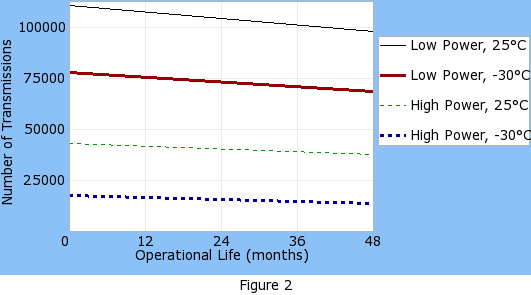
This graph provides a means to evaluate the total number of 4-byte Argos messages that can be transmitted (or "uplinked") by the A-1025 given a specified operational lifetime. Both low power and high power operational life predictions are shown for comparison. The transmissions can be scheduled as per user requirements using the A-1025 scheduler. The repetition rate, daily and seasonal duty cycles can be modified as required to meet study design. Modifications of these operational parameters can be made at the factory or by the researcher using the Telonics Product Programmer (TPP).
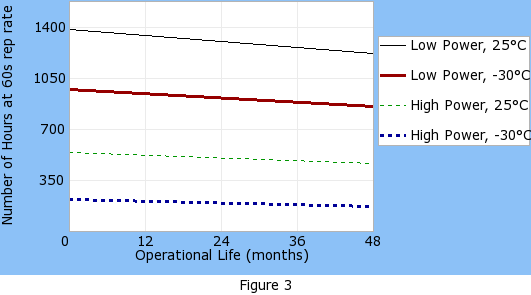
This graph is related to the first one above. The graph provides a means to evaluate the total number of hours a 4-byte Argos message can be transmitted (or "uplinked") by the A-1025 given a specified operational lifetime. Both low power and high power options are shown for comparison. The hours of transmission can be scheduled as per user requirements. The Argos repetition period used to generate this graph is 45 seconds. Daily and seasonal duty cycles can be modified as required to meet study design. Modifications of these operational parameters can be made at the factory or by the researcher using the Telonics Product Programmer (TPP).
Programmable Features
The A-1025 can be fully programmed at Telonics per the user's instructions so it arrives ready for deployment. Alternatively, researchers can choose to construct the data collection scheme and transmission parameters at their laboratory. Field programming the A-1025 can be done at any time prior to deployment.
TPP, the Telonics Product Programmer, is a software utility that allows the user to customize and program the unit's role and mission. The TPP demonstration software allows researchers to evaluate programming functions and data collection capabilities for all supported transmitter models for 30 days. The demonstration version of TPP is fully functional with the exception that it does not support actual programming of hardware. Users can purchase the "software key" to convert their demo version into a fully operational program.
Programmable Transmission Parameters
- ID code: Any valid 20-bit or 28-bit Argos ID code
- Repetition period: 5 to 3600 seconds, as authorized by Argos
- Seasons: Up to 32 intervals of time (1 day to 100 years, in 1 day increments) in which on periods occur
- Frequency: 401.618 MHz to 401.680 MHz, as authorized by Argos
- Transmission power level of 500 mw or 1 w
Sensors and Data Collection Programming
Pressure (Depth of Dive) Sensor:
- measures pressure and determines the animal's depth below sea level (depth ranges from 0 to 3515 meters in one meter increments).
- provides the raw data for calculation of maximum dive depth and time spent in specified depth layers during user specified intervals.
- provides the data for a profile of a single dive or series of dives (up to 32 samples per dive).
- is recalibrated automatically when the animal surfaces, and periodically while the animal remains on the surface to maintain accuracy.
Saltwater Switch (SWS) The SWS functions to:
- determine when the unit (animal) is diving by establishing a qualified dive and suppress transmissions during the duration of the dive. A qualified dive occurs after the duration of the dive exceeds a user-determined time period (usually a few seconds). The qualification period distinguishes between "splashes" and "real" dives.
- calculate dive information during a user-specified time interval. The information can include the number of dives, maximum dive time, average dive time, and/or total time underwater during the sampling interval.
- provide individual dive durations.
- determine a "haul-out" condition and shut down Argos uplink transmissions after a user-determined time interval has elapsed to conserve battery life.
Temperature Sensor: Measures temperature between -40 to +70°C, ±1°C accuracy.
Low Voltage Sensor: Determines the battery condition by measuring the battery voltage during transmission.
Two additional data collection options exist but, are not specifically designed for marine applications. There may be instances where specific research designs may use these options.
Activity Sensor: Determines animal activity level based on animal movement measured within a specified interval.
Mortality Sensor: Infers whether or not the animal is dead by comparing the animal activity level to a specified threshold.
Configuration Options
Antenna and Saltwater Switch (SWS) Options
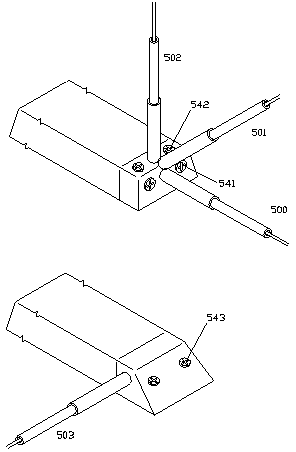
The drawings depict the various antenna exit angle options available: Option 500 exits at 0 degrees, Option 501 exits at 45 degrees , Option 502 exits at 90 degrees (Option 502 is the default option that is installed if no other option is specified). Option 503 exits the antenna at an angle that is most suitable to dorsal fin mounts. The SWS position options are also shown: Option 541 places the switch on the "front" of the unit (and is the default option that is installed if no other option is specified). Option 542 places the switch on "top" of the unit and must be specified at time of order. Option 543 is available only when antenna option 503 is specified.
Color Options
- Option 101: Olive drab Green (standard if not designated)
- Option 102: Black
- Option 103: White
- Option 104: Yellow
Application and Attachment Notes
The A-1025 is designed for attachment to marine turtles and marine mammals.
Turtles
The A-1025 can be attached to "hard shelled" turtles using accepted methods that employ fiberglass strips and an epoxy resin to directly secure the unit to the carapace. Descriptions of successful techniques and accepted materials are described in the biological literature. As a cautionary note, highly exothermic epoxies should be avoided as excessive heat generated during the curing process of the resin can result in damage to the turtle's lungs. Please consult the appropriate literature or work with researchers who have successfully applied units with this attachment procedure.
Turtles that do not have hard shells can be successfully instrumented using various harnessing techniques. Once again please consult current literature and experienced individuals who have successfully instrumented these animals using harnessing techniques.
Marine Mammals
The A-1025 configuration can be attached to these mammals using a variety of attachment techniques depending upon the animals under study. Please consult the biological literature and consult directly with experienced individuals who have successfully instrumented these species to assure that appropriate techniques are utilized.
Pinnepeds: Pinnepeds can be instrumented by "epoxying" or "gluing" the unit using a cyanoacrylic ("super glue") directly to the hair. Units are typically positioned on the head or back to assure exposure during surfacing. The attachment, when properly applied, can last until the animal undergoes a normal molt.
For longer-term attachment, flipper mounts can be used; however, it is often difficult to obtain Argos locations at sea using this technique, as the flipper may not always break the surface.
Cetaceans: Dolphins and small whales that can be captured and physically restrained during the instrumentation process typically utilize various forms of dorsal fin mounts.
Large cetaceans that cannot be restrained for the instrumentation process typically use a remote delivery system. The unit deployed is part of a projectile that is implanted into the blubber layer leaving only the antenna exposed. This model is probably not appropriate for remote delivery systems.
Specifications
Mechanical
| Size | 2.4 x 4.85 x 1.23 in
6.0 x 12.3 x 3.1 cm |
|---|
| Weight | 331 grams |
|---|
| Pressure Sensor | Yes |
|---|
| Antenna Length | 7.0 in
178 mm |
|---|
Electrical
| Electronics | ST-20RF |
|---|
| Power Source | Lithium Cell |
|---|
| Low Power Level | 500 (Typ) mW
27 ±2 dbm |
|---|
| Low Power Life | 1874 hours |
|---|
| Low Power Operating Temperature | -30 to +60 °C |
|---|
| High Power Level | 1000 (Typ) mW
30 ±2 dbm |
|---|
| High Power Life | 739 hours |
|---|
| High Power Operating Temperature | -30 to +60 °C |
|---|
| Argos Transmission Frequency | 401.618 to 401.680 MHz |
|---|
| Modulation (BPSK) | -1.1 to +1.1 ±0.1 radians |
|---|
| Quiescent current (typical) | 3 µA |
|---|
| Spurious emissions | -45 dB |
|---|
1. Operational life expectancy is based on a continuous series of transmissions of a 4-byte Argos message at a 45-second repetition rate at 25°C.
Related Products
Related Software
Technical Notes
Related Links to Information on Other Websites
Regulatory Information
Service Commitment
Since 1970, Telonics has built a reputation based on product quality, product support, service, and customer satisfaction. Telonics strives to produce the highest quality products, and to support those products accordingly.
Because of extreme conditions and the unpredictable nature associated with most telemetry applications, problems occasionally arise. Most problems can be resolved quickly. In all cases, we hope to be able to work in partnership with users to resolve problems to the user's satisfaction and to uphold our demonstrated commitment to excellence. If problems should arise, all products must be returned to our factory for failure analysis.
Warranty: Argos Systems - Show
Telonics warrants its Argos products to be free from defects in material and workmanship for a period of one year from the date acquired. Telonics does not warrant batteries.
If a defect occurs, return the equipment to us within the proper time frame at the following address: TELONICS, 932 E. IMPALA AVENUE, MESA AZ USA 85204-6699. The customer shall arrange for and pay all shipping, insurance and related charges incurred in the shipment to and from Telonics under this warranty. Damage to any equipment resulting from misuse, accidents, unauthorized service, extreme conditions, or other causes, is excluded from this warranty. Telonics does not assume responsibility for loss or damage to equipment during shipment. Telonics does not assume responsibility for delays resulting from shipment on commercial or private carriers. We insure all equipment shipped from our facility and suggest that shipments to Telonics also be insured.
Upon the timely return to our facility, if defective, the product will be replaced or repaired at our discretion at no cost to the customer. This remedy is the exclusive remedy. This product is supplied without any further warranties or conditions, expressed or implied, including warranties of merchantability, quality or fitness for particular reason or those arising by laws, statutes or trade usage or course of dealing.
The entire risk, as to the results and performance of the product, is assumed by the customer. Neither Telonics, nor its suppliers, shall have any liability to the customer or any other person or entity for any indirect, incidental, special, or consequential damage whatsoever, regardless whether Telonics has been told of the possibility of such damages or that such damages might be foreseeable. Telonics has no responsibility or liability for the claims of any third party. The maximum aggregate to the customer, of Telonics and its suppliers, shall not exceed the amount paid by the customer for the product.