
![]() |
Quality Electronics for Wildlife, Environmental Research, and Special Applications |
![]() |
|
|
www.telonics.com / products / vhfImplants / heartrate.php |
Page last updated on Wednesday February 23, 2011 |

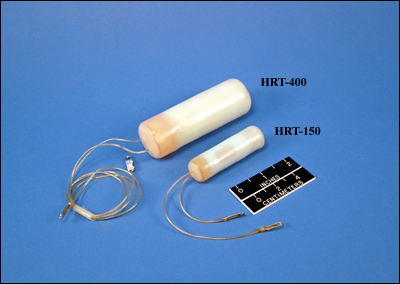
Figure 1. Heart Rate Units
Four configurations of heart rate transmitters are described in the table. Each configuration has dual water barrier technology and each unit is designed to be fully implantable. In mammals, the unit is typically placed in the abdominal cavity - one electrode is placed near the sternum while the other is physically separated and often placed on the last floating rib. The exact positioning of the electrodes must be determined by the researcher and optimized for individual species. Seeking a position for electrode implantation which maximizes the QRS complex of the cardiac depolarization is important, as is minimizing the P and T waves of the EKG waveform. The QRS depolarization event triggers a single transmission of the heart rate unit. The units have an automatic gain control (AGC) to help ensure that the threshold voltage can be established and maintained. The AGC helps compensate for changes in body position and the build up of collagen in the tissue near the electrode implantation site over time. Units are microprocessor controlled and they can be ordered with duty cycling. This allows the units to be implanted at any time of year with follow-up monitoring at established duty cycle time intervals. For example, a unit could be surgically implanted in a bear during the spring, turned on when the animal begins to prepare for hibernation, turned off for most of the winter, and turned on again when the animal is expected to come out of hibernation. Similarly, in birds the unit could be implanted in fall, turned off in winter, and turned on to study energetics of nesting, egg laying, and brood rearing. Duty cycling can extend the operational life of small implants and time monitoring of physiological events to appropriate periods of time. Telonics heart rate units also feature a failsafe pulse rate. The transmitting unit assumes this pulse rate whenever the HR detection circuitry cannot detect the depolarization of the heart muscle. If the subject animal dies this failsafe pulse rate allows the researcher to recover the carcass and the heart rate unit.
| Config | Dimensions (in, cm) | Unit Weight (g) | Transmitter Electronics | Operational Life @60BPM Std Power | Operational Life @60BPM Low Power | Microprocessor Control Options |
|---|---|---|---|---|---|---|
| HR-150 | 2.7 x 0.9 6.9 x 2.3 |
35 | MK7 | 4.1 | 10.5 | MDC |
| HR-200 | 3.0 x 0.9 7.6 x 2.3 |
40 | MK7 | 7.5 | 19.2 | MDC |
| HR-300 | 3.7 x 0.9 9.4 x 2.3 |
60 | MK7 | 9.2 | 23.5 | MDC |
| HR-400 | 4.3 x 1.3 11 x 3.3 |
120 | MK7 | 16.9 | 43.2 | MDC |
* Note: For Heart Rate transmitters, operational life is dependent on the heart rate of the animal.
Specifications for Transmitter Electronics
MK8 Transmitter General Specifications
Opt. MDC MK8 Duty Cycles. Transmitters can be programmed to cycle through up to eight sequential time periods or "duty cycles" in order to extend transmitter life. Within each duty cycle, the transmitter can either be "on" or "off". Pulse rates can be uniquely defined for each "on" duty cycle. Each duty cycle can be defined from eight seconds to approximately 50 months in length. Duty Cycle timing begins at the moment the magnet is removed to initialize the transmitter. Upon completion of the last programmed Duty Cycle Period, the transmitter begins again at the first duty cycle.
1. Most Telonics implantable telemetry transmitting subsystems utilize an internal transmitting
antenna structure. The structure is contained inside the packaging of the implant. This type of
antenna can be tuned to either air or the dielectric of the body. The tuning choice will affect
where (in air or in the body) the maximum range performance will be achieved. If the unit is tuned
to air, the unit's best performance will be achieved when air surrounds the implant. If the implant
antenna is tuned to the dialectic of the body, the best performance from the implant will be
achieved when the implant is actually inside the body cavity. Note: When testing, it is necessary
to place the implant in the medium in which it will be expected to operate. This is particularly
true when trying to obtain more accurate range performance test data.
For extremely large bodied animals (over 100 pounds), it should be noted that the large mass
reduces the effective radiated power of the implant, thereby reducing the range performance of the
system. When implanting small terrestrial mammals, the implant is often carried only a few inches
off the surface of the earth and thus the range is reduced because line-of-sight range is also
reduced under these conditions.
2. Cold method sterilization should be utilized when sterilizing units prior to implantation. The physiological wax can melt with hot method sterilization techniques compromising the units' moisture repelling properties. Also note, units should be stored in a cool environment (such as a cooler) during transportation in vehicles, or kept in a cool environment during periods of storage.