
|
Quality Electronics for Wildlife, Environmental Research, and Special Applications |
| Home Page | Company Info | What's New | Software | Manuals | Quarterly | Ordering Info |
![]() |

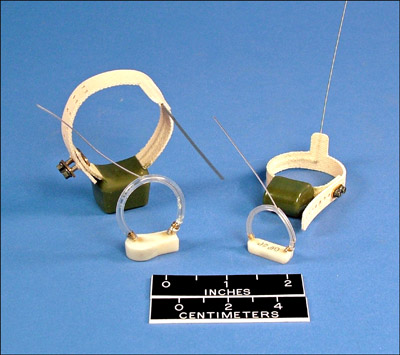
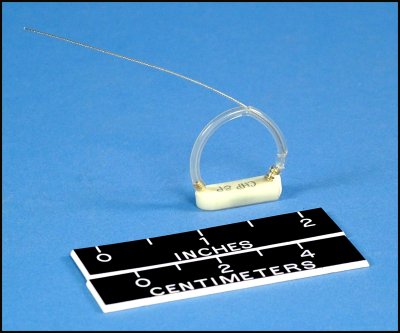
Figure 1. CHP Configurations
The CHP series of transmitters was developed in the mid 1990s in response to a need by the wildlife field for an ultra small transmitter which could be configured in various ways for small mammals. Most of the technology developed prior to the CHP transmitters was based on miniature circuits from the early 1960s which were made small by simply eliminating components from the circuit itself. These early miniature transmitters were small, but they were very unstable in their performance characteristics. Many of these early designs drifted in frequency and the transmission was cluttered with unwanted spurious signals throughout the frequency spectrum, resulting in a characteristic "chirp" sound. Fortunately, these units were low in radiated power so they often did not interfere with other radio services. However, they wasted power, exhibited very low efficiency, interfered with one another, and often exhibited poor range performance. They also had very unstable pulse rates and pulse widths which made monitoring the units difficult. All these problems were made even worse as the battery voltage changed as the energy capacity of the battery was depleted over the unit's operational life or as temperature conditions changed from one trip a field to the next. For many years there was no alternative to these simple one stage circuits.
CHP technology which appeared in the 1990s, took a different approach to miniaturization as compared to the early technology. The concept was to use virtually the same circuit that was used in larger state-of-the-art wildlife transmitters but in this case, incorporate extremely miniaturized components and highly integrated circuits which retained their satiability but were physically small and could operate at very low voltage required by the small batteries inherent in these subsystems. When first introduced this circuitry was successful but unfortunately, the cost of the systems was higher then the old style units (which sold for around $125 - $150). The performance and reliability however, was very good. In the past few years, the price of the components we use to build these ultra small transmitting units has come down, making these units cost competitive with virtually any technology currently used in manufacturing wildlife transmitters.
Any radio transmitter system used in the wildlife field must be as "moisture proof" as possible or it will not achieve its full operational life when deployed. It will leak before it runs out of battery energy and thus fail prematurely. In the case of these very small transmitting units, packaging is still important even though many of the smallest units may only have sufficient battery capacity to operate for a few weeks. In the early days of radio telemetry most companies used epoxies, acrylics, or urethanes. In many case these polymeric materials were virtually painted onto the electronics and battery assembly. Such approaches provided a thin, fragile coating of the polymer moisture barrier. More material could be used to increase the effectiveness of the moisture barrier somewhat; however this was rarely done, as the resulting increase in packaging weight was a major consideration. Unfortunately, this "paint it on" approach often meant that the effectiveness of the water resistant layer was highly variable. It varied with the mix of the polymer selected, the mixing process, and the environmental conditions such as the humidity on the day of assembly, and quite honestly on the level of concentration of the assembler that particular day. The effectiveness of the moisture barrier was variable from a given supplier, and between suppliers. In short, the manufacturing process was difficult to control and not very repeatable.
Fortunately today's polymeric processes are more refined, application techniques are more controlled and the polymers themselves are more suitable to these applications than in the past. The packaging design of Telonics' CHP series transmitters eliminates the variability of previous construction approaches by placing a closely controlled, uniform amount of carefully selected polymer around the electronics and battery - completely eliminating the human variability experienced in previous packaging approaches. In short, the effectiveness of the polymer in its role as a waterproofing agent is better controlled and the reliability of these systems has increased in direct proportion.
The short operational life of many of the very small CHP units means that they must be rebatteried for redeployment. All CHP units are refurbishable to the original condition. (Sensors cannot be added to configurations at refurbishment, they must be specified at when the units are initially procured). The weight of the systems (including the transmitter electronics, battery, antenna, and polymeric package) ranges between 1.2 grams and 13.5 grams. The operational life is directly related to the weight of the subsystem and ranges between three weeks and 25.7 months depending on the pulse rate. The units can be specified to include a temperature sensor. Some models can be equipped with a tip switch for activity sensing capability. The data are transferred to the user by changes in the pulse rate.

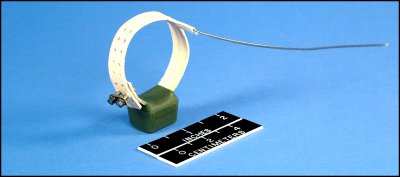
Figure 2
CHP configurations for small mammals are designed to maximize the operational life
of the configuration while providing a reasonable level of protection and durability
consistent with maximum operational life. Because these configurations are mounted on
very small collars, the antenna is necessarily much shorter then the ideal quarter
wavelength monopole "whip" antenna which results in reduced signal radiation. The
range of these systems is usually less then a kilometer on the ground. Several
collar designs are provided as examples but other collar configurations are possible.
Please consult with our staff if the configurations provided do not meet your
requirements.
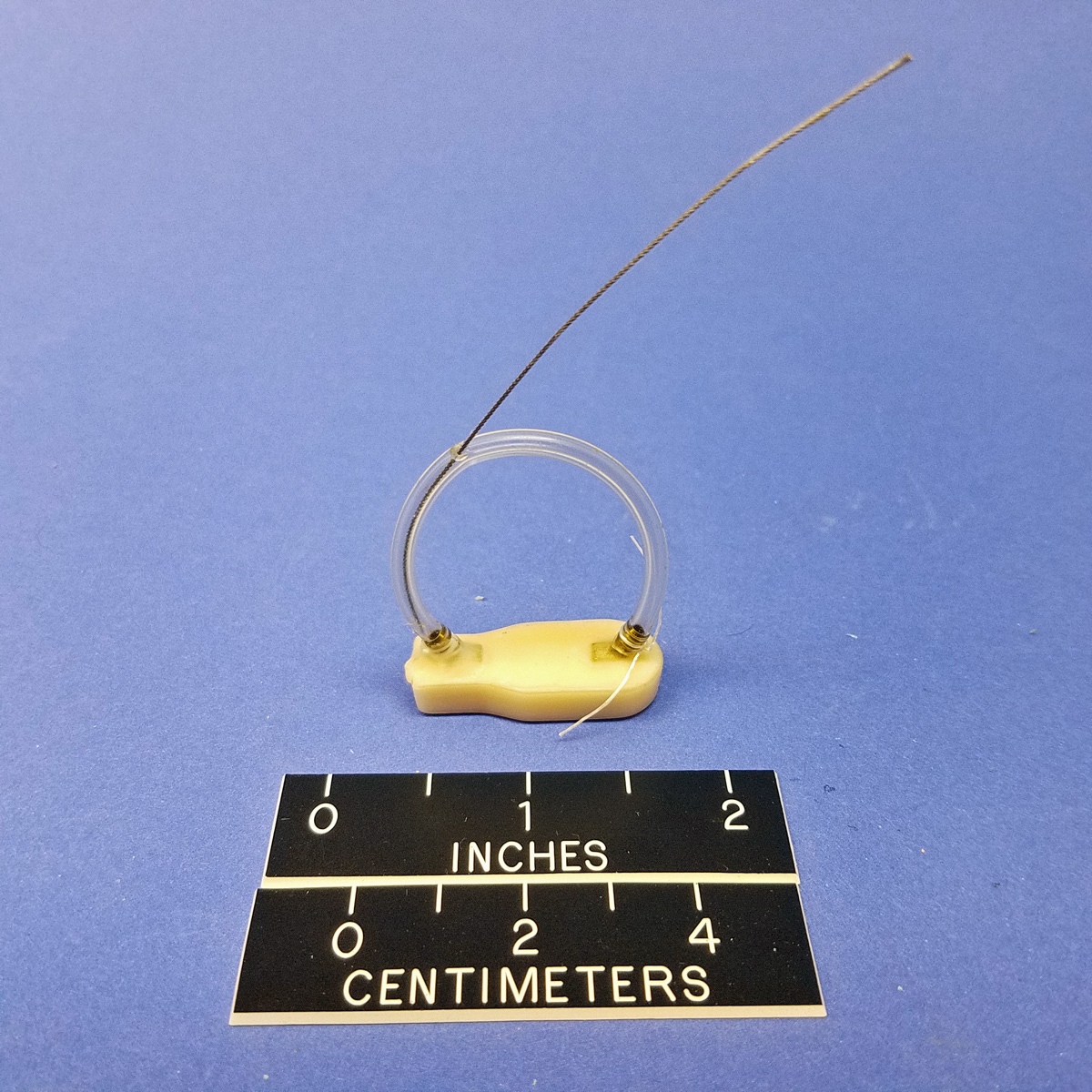
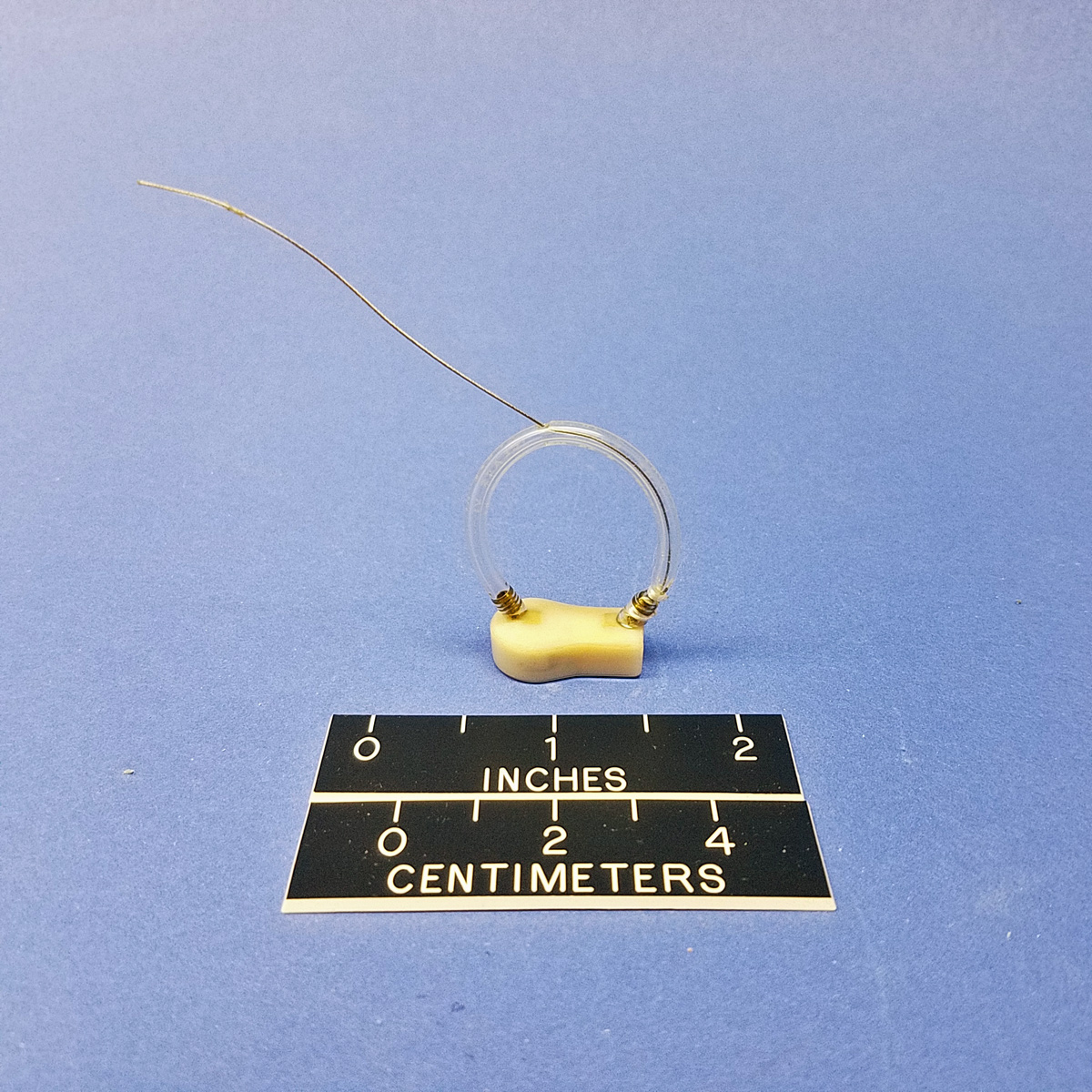
(Tuned loop antennas vs. short whip antennas vs. internal helix antennas)
Key Features
How to use this table: The information contained in the following table is provided in a manner to allow comparison of models. To sort by model attributes i.e. weight, CLICK ON THE COLUMN HEADING. To obtain more specific information for a model, CLICK ON THE MODEL NUMBER.
| Configuration | Size (in, cm) | Unit Weight(g) | Collar Characteristics | Life @ 60BPM (months) |
Life @ 35BPM (months) |
Conventional Sensor Options | Species |
|---|---|---|---|---|---|---|---|
| CHP-4P | 1.0 x 0.8 x 0.55 2.54 x 2.03 x 1.4 |
13.5 | 1/16" Butyl | 18 | 25.7 | S2 | marmot, polecat, otter, bare earred marmoset, hedgehog, black lion tamarin |
| CHP-5P | 1.34 x 0.52 x 0.27 3.41 x 1.32 x 0.69 |
6.8 | Tygon tubing | 8.5 | 13.6 | S2 | marmot, polecat, otter, bare earred marmoset, hedgehog, black lion tamarin |
| CHP-6P | 0.90 x 0.52 x 0.27 2.28 x 1.32 x 0.69 |
3.7 | Tygon tubing | 4.2 | 6.8 | S2 | marmot, polecat, otter, bare earred marmoset, hedgehog, black lion tamarin |
| CHP-7P | 0.83 x 0.35 x 0.27 2.11 x 0.89 x 0.69 |
2.2 | Tygon tubing | 1.6 | 2.7 | S2 | marmot, polecat, otter, bare earred marmoset, hedgehog, black lion tamarin |
| CHP-8P | 0.80 x 0.32 x 0.15 2.03 x 0.81 x 0.37 |
1.2 | Tygon tubing | 0.7 | 1.1 | S2 | marmot, polecat, otter, bare earred marmoset, hedgehog, black lion tamarin |
| CHP-9P | 0.75 x 0.55 x 0.6 41.91 x 1.4 x 1.52 |
10 | 1/16" Butyl | 8.5 | 13.6 | S2 | marmot, polecat, otter, bare earred marmoset, hedgehog, black lion tamarin |
Notes:
1. Transmitter weight includes a 4" lightweight antenna and Standard Attachment Option.
2. Sizes shown are for the main outline only. Attachment options may increase the
overall dimensions.
OPT. S2 Temperature Sensor. Sensor provides pulse rate which varies according to temperature within the transmitting subsystem. User specifies desired pulse rate at anticipated median temperature and approximate range of temperatures to be monitored. Pulse rate increases at higher temperatures and decreases at lower temperatures.
How much range can be achieved from these small transmitters under
field conditions?
The range of any transmitting system is a function of all the components of the system
including the sensitivity, bandwidth, and noise figure of the receiver, the loss in the
coaxial cable that connects the receiver to the antenna, the gain, impedance match and
tuning of the antenna, the antenna on the transmitter on the animal, the ability of the
battery to supply the necessary current to the transmitter so it can be converted to a
radio signal, the ability to remain in line of sight, the density and composition of
the vegetation, and the efficiency and RF output power level of the transmitting
device. Because of all the variables that collectively determine range performance,
manufacturers of radio telemetry cannot honestly guarantee a certain range performance
from a telemetry system. It is commonly assumed by end users that if the range of a
system is not what was expected, the most likely explanation is that the transmitter's
output is the most likely problem. Often that is not the case. In fact, with
state-of-the-art transmitters, the actual power level is well controlled over the
battery life and specified operational temperature range of the battery. If a yard
stick is required to plan a program the following rule of thumb helps. Most very small
transmitting units must operate using very small power/battery systems which are
restricted to temperatures above zero degrees centigrade. The battery voltage and
current delivery capability generally determine how much transmitted power we can
expect to deliver to the antenna. If we assume that the rest of the system is
state-of-the-art, then small transmitters using the CHP technology can deliver range
performance of 0.5-2 km on the ground to a handheld antenna and 5 km or more to an
aircraft circling above with a properly mounted aircraft antenna system.
Will I get more range if I use bigger antennas at the receiving site?
The answer to this question must also be qualified... but in general the answer is
yes. The rated gain of an antenna is directly related to range performance. For
every 6db of gain added to the antenna the line-of-site range doubles. BUT... to achieve
the rated gain of the antenna the user must mount the antenna in a manner which does
not detune the antenna or disrupt the pattern of the antenna. This is not always a
very easy assignment. The larger the antenna the more difficult it is to use in the
field. In general, larger antennas really means more antenna elements which means
that the entire antenna must be properly mounted further off the ground and away from
conductive surfaces. If one does not accomplish proper mounting of the antenna there
is no increase in range performance and all you end up with is more metal in the air
to attract lighting strikes.
How long does it take between time of order and receiving CHP equipment?
The typical delivery schedule is about 8 weeks when the frequency determining crystals
must be ordered specifically for your study. Premium delivery of crystal is sometimes
possible but can add 20-40 dollars to the cost of the unit. We do carry crystals in
stock for many commonly used frequency bands. If crystals are in stock the lead time
is typically 4 weeks.
Can units be rebatteried?
Yes. This process is called refurbishment. The process actually involves much more than
simply putting on a new battery. It really involves recovering the electronics,
retesting the electronics and rebuilding the configuration to its original configuration.
When the unit is returned to you from our factory it is like new and has a like new
warranty. The cost to refurbish a unit is about two thirds the current cost of the
configuration.
Can the user replace the batteries to save money?
The transmitter does belong to you or your agency. You can do as you will with the
unit. Because of the complexity involved, if you decide to replace the batteries we
can't offer any support for that system in the future. Unfortunately, various groups
and individuals have different skill levels and access to support services. Some
individuals may be capable of accomplishing the tedious work without doing damage to
the unit, others cannot. Since there is no way for Telonics to oversee the
refurbishment we can not support or warranty the results.
Can the configuration be changed for use with another species?
Yes in the case of the larger two of the three models, the CHP-5P and CHP-6P (i.e.,
a 6P can be converted to a 5P and the converse). The CHP-8P, the smallest configuration
in the CHP series, utilizes unique techniques of miniaturization which do not interchange
with the larger models and therefore cannot be modified to other configurations. The
CHP-5P and CHP-6P units can be retrofitted to another configuration using the same pulse
rates, pulse widths, and sensors. They can even be changed from a unit that mounts on a
bird to a unit with a collar for a small mammal. However, the process can, in some cases
cost more then a refurbishment. Thus in some cases a new unit is a better option.
Can the user get a custom configuration if the existing
configuration does not meet the study requirements exactly?
Yes. Specific CHP configurations have been developed for various groups of animals and
some of the options are listed below. As with all systems the least expensive approach
is to use an existing configuration. In many cases there is a certain history associated
with a configuration and often the field testing has already been completed and the
design is refined. However, Telonics often does custom configurations for specific
applications. Those custom applications necessarily cost more to cover the consulting,
engineering, procurement of special materials, custom building, and documentation of
the application. Please also recognize that any new design involves additional risk
for the user because there is no history of use in the field. So if cost is the main
driver in your choice of a telemetry transmitting subsystem try to select from existing
configurations. Remember however, that for each of the many configurations listed, some
researcher tried it for the first time. Our engineers and biologists have the experience
to provide the advice for special applications which will significantly increase your
probability of success.
For more information on CHP Microminiaturized Subsystems, please contact info@telonics.com.

932 E. Impala Ave., Mesa, AZ, 85204-6699 U.S.A.
Tel: 480-892-4444 FAX: 480-892-9139
Email - info@telonics.com