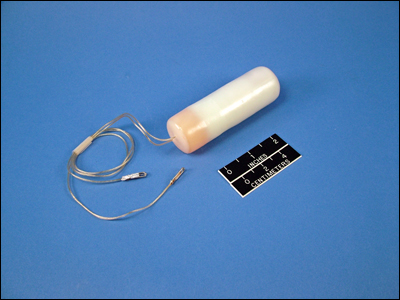
The MK8 Transmitter is a single frequency, microprocessor controlled pulsed-CW transmitter, designed for operation in the 140 - 220 MHz frequency range.
| Frequency Range | 140 - 220 MHz |
|---|
| Frequency Tolerance |
±17 ppm max @ 25°C
±25 ppm max -40°lC < Temp < +60°C
(<7ppm typical w/ variation in load impedance - 6:1VSWR)
(<3ppm typical over supply voltage range at room temperature)
|
| Temperature Range | -40°C to +60 °C (Note: Temperature range is for the transmitter only. The power supply must provide the required peak current and voltage requirements for the transmitter over the expected temperature range.) |
|---|
| Shutdown Component | Externally shutdown by presence of a small magnet |
|---|
| Output Power |
| Output Power Option | Peak Power Output Levels
Relative to Standard Power |
| Low | 0.5 x |
| Standard | 1 x |
| High | 2 x |
| Extra high | 5 x |
|
| RF Pulse Width | 15 msec standard
Can optionally be configured from 12 - 255 msec |
|---|
| Pulse Period | Configurable from 200 - 10000 msec (6-300 Bpm) |
|---|
| Spurious Emissions | Non-coherent Spurs <-50 dBc |
|---|
| Harmonic Suppression | Coherent Spurs <-10 dBc |
|---|
| Available Sensors |
Motion (Hg switch - activity/mortality) - options MS6, MA
Position (Hg switch - head up/head down) - option MS9
Temperature Triggered Mortality Sensor - option MS5
Temperature Measurement Sensor - MS4
| Option |
Resolution at standard center temperature of 37°C |
Calibrated Accuracy |
| MS4-400 |
0.4 deg |
±(0.6°C + cal. uncertainty*)
±20°C from center temperature
|
| MS4-400 |
0.4 deg |
±(0.9°C + cal. uncertainty*)
±40°C from center temperature
|
| MS4-410 |
0.1 deg |
±(0.15°C + cal. uncertainty*)
±10°C from center temperature
|
*(Note: "Cal. uncertainty" is the error inherent in the calibration procedure. This value is dependant on the end users calibration procedure and equipment accuracy.
For example, if the calibration process measures temperature to within ±0.1°C, then the MK8 calibrated accuracy would be:
- For 0.4 deg resolution option
±(0.6deg + 0.1deg) = ±0.7degC (±20°C)
±(0.9deg + 0.1deg) = ±1.0degC (±40°C)
- For 0.1 deg resolution option
±(0.15deg + 0.1deg) = ±0.25degC (±10°C)
|
| Seasonal Timing |
8 factory programmable on-off duty cycles - option MDC
Typical timing accuracy of < ± 30 min/yr is reasonable for most applications
Chart reflects known error limits
| Temperature (°C) | Error Limits (min/yr) |
| -40°C | ~ -73 to -105 (extrapolated) |
| -20°C | -25 to -58 |
| 0°C | 2.6 to -29 |
| 25°C | ±16 |
| 50°C | 2.6 to -29 |
| 70°C | -25 to -58 |
|
| FCC Emission Designator |
1k00P0N
* California Users - The MK8 transmitter exceeds the emission designator requirement of 2k00P0N for operation in California. The MK8's 1k00P0N emission designator is identical to 2k00P0N except that it occupies only half of the 2 kHz bandwidth allowed by the State of California for wildlife tracking. |
1: Extended temperature ranges are available. Contact factory for details.
Telonics Inc. ships all systems containing lithium batteries in accordance with the US Department of Transportation rules for hazardous materials set forth in 49CFR and the IATA Dangerous Goods Regulations.
Since 1970, Telonics has built a reputation based on product quality, product support, service, and customer satisfaction. Telonics strives to produce the highest quality products, and to support those products accordingly.
Because of extreme conditions and the unpredictable nature associated with most telemetry applications, problems occasionally arise. Most problems can be resolved quickly. In all cases, we hope to be able to work in partnership with users to resolve problems to the user's satisfaction and to uphold our demonstrated commitment to excellence. If problems should arise, all products must be returned to our factory for failure analysis.
The Implantable VHF Transmitting Subsystem includes the following main components: internal digital and radio frequency electronics comprising the transmitter, power supply (battery), exterior packaging, physiologically compatible coating, and transmitting antenna. A refurbished Subsystem is warranted as if the Subsystem was purchased new, unless otherwise stated.
Telonics warranties only the following with respect to the Subsystem:
1.1 The "L" series standard implants are warranted in the following manner. The internal electronics (excluding batteries) are warranted to be free from defects in materials and workmanship and to perform to the operational specifications over the specified operating temperature range as published by Telonics for the rated operational life of the Subsystem (as recorded on the final test data sheet accompanying the unit), up to a maximum of one (1) year from the date of initial shipment of the Subsystem by Telonics.
1.2 The exterior packaging integrity of all implants with internal antennas are warranted for the full operational life of the Subsystem, up to a maximum of one (1) year from the date of initial shipment of the Subsystem by Telonics.
1.3 The exterior packaging integrity of implantable CHP subsystems with external antennas are warranted for the operational life of the Subsystem, up to a maximum of three (3) months from the date of initial shipment of the Subsystem by Telonics.
Limitations:
Although each Subsystem is supplied with a power supply in the form of a battery, Telonics does not manufacture batteries (electrochemical cells), and therefore cannot warranty the battery lifespan, mechanical integrity or other battery performance issues. However, Telonics conducts extensive testing of all types of electro-chemical subsystems to determine suitability to the application. Once an electrochemical system is chosen for a configuration, testing procedures are employed at Telonics to evaluate every individual battery that is installed in each transmitting subsystem. Even using these advanced testing procedures it is not possible to determine a specific battery's lifespan or mechanical integrity.
Telonics conducts tests to assure that each unit is transmitting at the power level selected by the user. Actual range performance is a system characteristic dependent upon numerous conditions including receiver sensitivity and noise figure, receiving antenna tuning and pattern, transmitter antenna integrity, line of sight conditions in the field, and vegetation and habitat conditions and other factors specific to individual study sites. Therefore it is not possible to warranty a minimum range that will be achieved for units deployed in the field.
"Packaging integrity" as applicable to 1.2 and 1.3 above, is limited to normal wear as encountered when implanted in the animal. Fatigue and/or breakage of the electrode leads used in heart rate transmitters are not covered under warranty.
It is the purchaser's obligation to make certain that it orders the correct size and type of Subsystem for the particular type and size of animal that the Subsystem will be applied to, and no warranty is expressed or implied for any failure to meet operational specifications due in whole or in part to use of an incorrect size or type of Subsystem.
No warranty is expressed or implied with regard to abnormal events or damage due to human actions such as gunshot damage, vehicle encounters, etc. Further, no warranty is expressed or implied with regard to damage resulting from misuse, accidents, unauthorized service, extreme conditions, or other causes not specifically enumerated herein.
The entire risk, as to the results and performance of the Subsystem, is assumed by the customer. Neither Telonics, nor its suppliers, shall have any liability to the customer or any other person or entity for any indirect, incidental, special, or consequential damage whatsoever, regardless whether Telonics has been told of the possibility of such damages or that such damages might be foreseeable. Telonics has no responsibility or liability for the claims of any third party. Telonics' and its suppliers' maximum aggregate liability shall not exceed the amount paid by the customer for the Subsystem.
Exercising the Warranty
If a defect occurs, return the Subsystem to Telonics within the applicable time frame noted above at the following address: TELONICS, 932 E. IMPALA AVENUE, MESA AZ USA 85204-6699. Telonics does not assume responsibility for loss or damage to equipment during shipment. Telonics does not assume responsibility for delays resulting from shipment on commercial or private carriers. We insure all equipment shipped from our facility and suggest that shipments to Telonics also be insured. Customer shall arrange for and pay all shipping, insurance and related charges incurred in the shipment of Subsystems to and from Telonics under this warranty.
Upon the timely return to our facility within the applicable time frame noted above, if the exterior packaging integrity and/or internal electronics (excluding batteries) are defective, the Subsystem will be replaced or repaired, at Telonics' sole discretion, at no cost to the customer, other than shipping charges. This remedy is the exclusive remedy. This product is supplied without any further warranties or conditions, expressed or implied, including warranties of merchantability, quality or fitness for particular reason or those arising by laws, statutes or trade usage or course of dealing.
The above warranty extends only to the original purchaser and does not cover any Subsystem which is resold or otherwise transferred from the original purchaser to another party. The warranty will be extended to customers who purchase the Subsystem directly from a Telonics-authorized distributor.