A-3210 Argos Transmitter
The information below on discontinued products is provided for individuals who are still using these older systems. Product descriptions may be time sensitive or even outdated. Please contact Telonics if you have questions.
| Dimensions L x W x H |
Canister Weight
(g) |
Low power
(mW) |
Low power
life (hours)1 |
Low power
temp (°C) |
High power
(mW) |
High power
life (hours)1 |
High power
temp (°C) |
VHF Beacon
Onboard |
2.0 x 1.6 x 1.9
5.0 x 4.0 x 4.8 |
663 |
500 (Typ) |
1427 |
-20 to +60 |
1000 (Typ) |
631 |
+17 to + 60 |
Yes |
Telonics designed the A-3210 configuration specifically for terrestrial species.
Key Features
- Operational life is extended by a factor of three relative to older transmitter models, due to ultra-low quiescent current and highly efficient radio transmission circuitry.
- Real-time clock calendar (RTC) controls all timing functions.
- Powerful data collection and transfer capabilities allow the units to acquire, queue, and transmit temperature and activity information.
- User programmability allows researchers to reprogram units in the field and change their role and mission.
- On-board sensors can be activated or deactivated in the field. Data collection regimes and schedules can be altered as required. Sensor data can be enhanced or deleted from Argos uplink transmissions.
- Transmission schedules can be modified.
- Argos ID codes can be changed.
- Argos uplink transmission power levels can be modified to extend operational life or increase the probability of signal reception at the satellite.
- Argos uplink frequencies can be changed to frequencies in low noise channels to increase the chances of a successful uplink.
- Units can be refurbished to their original condition at the factory.
- Shutdown with a small magnet allows users to turn a unit "on" or "off". When turned "off", this model consumes about 8 μA. Given this low quiescent current level, users can store their units for extended periods with minimal impact on operational life.
Operational Life Information
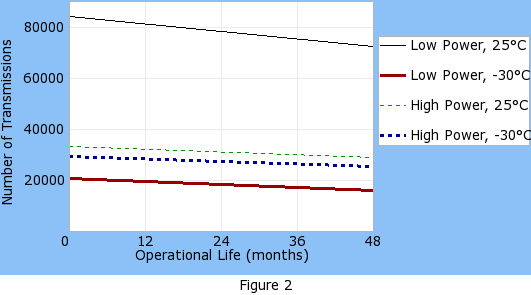
This graph provides a means to evaluate the total number of 4-byte Argos messages that can be transmitted (or "uplinked") by the A-3210 given a specified operational lifetime. Both low power and high power operational life predictions are shown for comparison. The transmissions can be scheduled as per user requirements using the A-3210 scheduler. The repetition rate, daily and seasonal duty cycles can be modified as required to meet study design. Modifications of these operational parameters can be made at the factory or by the researcher using the Telonics Product Programmer (TPP).
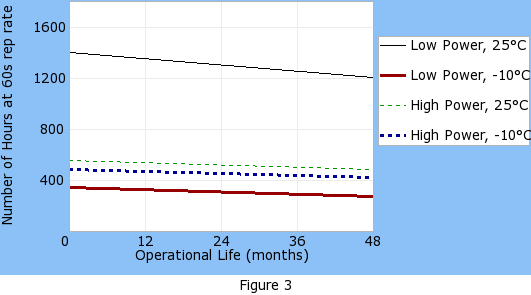
This graph is related to the first one above. The graph provides a means to evaluate the total number of hours a 4-byte Argos message can be transmitted (or "uplinked") by the A-3210 given a specified operational lifetime. Both low power and high power options are shown for comparison. The hours of transmission can be scheduled as per user requirements. The Argos repetition period used to generate this graph is 60 seconds. Daily and seasonal duty cycles can be modified as required to meet study design. Modifications of these operational parameters can be made at the factory or by the researcher using the Telonics Product Programmer (TPP).
Programmable Features
The A-3210 can be fully programmed at Telonics per the user's instructions so it arrives ready for deployment. Alternatively, researchers can choose to construct the data collection scheme and transmission parameters at their laboratory. Field programming the A-3210 can be done at any time prior to deployment.
TPP, the Telonics Product Programmer, is a software utility that allows the user to customize and program the unit's role and mission. The TPP demonstration software allows researchers to evaluate programming functions and data collection capabilities for all supported transmitter models for 30 days. The demonstration version of TPP is fully functional with the exception that it does not support actualprogramming of hardware. Users can purchase the "software key" to convert their demo version into a fully operational program.
Programmable Transmission Parameters
- ID code: Any valid 20-bit or 28-bit Argos ID code
- Repetition period: 5 to 3600 seconds, as authorized by Argos
- Seasons: Up to 32 intervals of time (1 day to 100 years, in 1 day increments) in which on periods occur
- Frequency: 401.618 MHz to 401.680 MHz, as authorized by Argos
- Transmission power level of 500 mw
Sensors and Data Collection Programming
Saltwater Switch (SWS) The SWS functions to:
- determine when the unit (animal) is diving by establishing a qualified dive and suppress transmissions during the duration of the dive. A qualified dive occurs after the duration of the dive exceeds a user-determined time period (usually a few seconds). The qualification period distinguishes between "splashes" and "real" dives.
- calculate dive information during a user-specified time interval. The information can include the number of dives, maximum dive time, average dive time, and/or total time underwater during the sampling interval.
- provide individual dive durations.
- determine a "haul-out" condition and shut down Argos uplink transmissions after a user-determined time interval has elapsed to conserve battery life.
Temperature Sensor: Measures temperature between -40 to +70°C, ±1°C accuracy.
Low Voltage Sensor: Determines the battery condition by measuring the battery voltage during transmission.
Activity Sensor: Determines animal activity level based on animal movement measured within a specified interval.
Mortality Sensor: Infers whether or not the animal is dead by comparing the animal activity level to a specified threshold.
Configuration Options
Color Options
Black, Blue, Brown, Gray, Olive Drab Green (standard if not designated), Orange, Red, White, Yellow
Collar Options
Standard collars (static)
Specifications
Mechanical
| Size | 2.0 x 1.6 x 1.9
5.0 x 4.0 x 4.8 |
|---|
| Weight | 663 grams |
|---|
| Antenna Length | UNK
UNK mm |
|---|
Electrical
| Electronics | ST-20RF |
|---|
| Power Source | Lithium Cell |
|---|
| Low Power Level | 500 (Typ) mW
27 ±2 dbm |
|---|
| Low Power Life1 | 1427 hours |
|---|
| Low Power Operating Temperature | -20 to +60 °C |
|---|
| High Power Level | 1000 (Typ) mW
30 ±2 dbm |
|---|
| High Power Life1 | 631 hours |
|---|
| High Power Operating Temperature | +17 to + 60 °C |
|---|
| Argos Transmission Frequency | 401.618 to 401.680 MHz |
|---|
| Modulation (BPSK) | -1.1 to +1.1 ±0.1 radians |
|---|
| Quiescent current (typical) | 25 µA |
|---|
| Spurious emissions | -45 dB |
|---|
| VHF beacon onboard | Yes |
|---|
1. Operational life expectancy is based on a continuous series of transmissions of a 4-byte Argos message at a 60-second repetition rate at 25°C.
Related Products
Related Software
Technical Notes
Related Links to Information on Other Websites
Regulatory Information
Service Commitment
Since 1970, Telonics has built a reputation based on product quality, product support, service, and customer satisfaction. Telonics strives to produce the highest quality products, and to support those products accordingly.
Because of extreme conditions and the unpredictable nature associated with most telemetry applications, problems occasionally arise. Most problems can be resolved quickly. In all cases, we hope to be able to work in partnership with users to resolve problems to the user's satisfaction and to uphold our demonstrated commitment to excellence. If problems should arise, all products must be returned to our factory for failure analysis.
Warranty: Argos Systems - Show
Telonics warrants its Argos products to be free from defects in material and workmanship for a period of one year from the date acquired. Telonics does not warrant batteries.
If a defect occurs, return the equipment to us within the proper time frame at the following address: TELONICS, 932 E. IMPALA AVENUE, MESA AZ USA 85204-6699. The customer shall arrange for and pay all shipping, insurance and related charges incurred in the shipment to and from Telonics under this warranty. Damage to any equipment resulting from misuse, accidents, unauthorized service, extreme conditions, or other causes, is excluded from this warranty. Telonics does not assume responsibility for loss or damage to equipment during shipment. Telonics does not assume responsibility for delays resulting from shipment on commercial or private carriers. We insure all equipment shipped from our facility and suggest that shipments to Telonics also be insured.
Upon the timely return to our facility, if defective, the product will be replaced or repaired at our discretion at no cost to the customer. This remedy is the exclusive remedy. This product is supplied without any further warranties or conditions, expressed or implied, including warranties of merchantability, quality or fitness for particular reason or those arising by laws, statutes or trade usage or course of dealing.
The entire risk, as to the results and performance of the product, is assumed by the customer. Neither Telonics, nor its suppliers, shall have any liability to the customer or any other person or entity for any indirect, incidental, special, or consequential damage whatsoever, regardless whether Telonics has been told of the possibility of such damages or that such damages might be foreseeable. Telonics has no responsibility or liability for the claims of any third party. The maximum aggregate to the customer, of Telonics and its suppliers, shall not exceed the amount paid by the customer for the product.